
God Abides with Us, Through the Holy Eucharist
Readings: 1st: Deu 8: 2-3.14-16; Ps 147; 2nd: 2Cor 20: 16-17; Gos: Jn 6: 51-58
This brief reflection was written by Fr. Njoku Canice Chukwuemeka, C.S.Sp. He is a Catholic Priest and a member of the Congregation of the Holy Spirit (Spiritans). He is a missionary in Puerto Rico. He is the Parish Priest of Parroquia la Resurrección del Senor, Canóvanas, and the Major Superior of the Congregation of the Holy Spirit (Spiritans), Circumscription of Puerto Rico and the Dominican Republic. He was the chancellor of the Diocese of Fajardo Humacao, Puerto Rico. Fr. Canice is a member of the Academy of Homiletics. For more details and comments contact him at: canice_c_njoku@yahoo.com, canicechukwuemeka@gmail.com
(https://orcid.org/0000-0002-8452-8392)
Today, we celebrate the solemnity of the Body and Blood of Christ or “Corpus Christi.” It originated in France in the mid-thirteenth century and was extended to the whole Church by Pope Urban IV in 1264. This feast focuses on two manifestations: the Holy Eucharist as the body of Christ and the Church as the body of Christ.
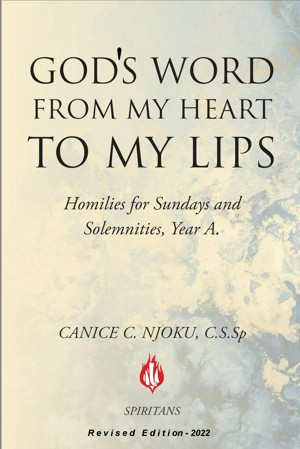
Available now on
Smashwords: https://www.smashwords.com/books/view/1179451
Amazon: https://www.amazon.com/dp/B094YSGTZF
In the study of Human Nutrition, the following statements are very factual: “You are what you eat” and “good food nourishes the body.” While the physical food we eat nourishes the body, spiritual food nourishes our soul, prepares, and preserves it for eternity. The Eucharist, as the body and blood of Christ, not only makes the soul fit to dwell in a healthy body but also makes it fit to appear before God.
In the first reading, Moses reminded his brethren of how God took good care of them by nourishing and sustaining them in the desert: “He humbled and fed you with manna. Do not forget the Lord your God, who brought you water and fed you with manna in this dry place.” Through this, God demonstrated his love and ability to sustain His chosen people physically and spiritually. In our time, God has given us the Eucharist for our spiritual nourishment. Hence, the Holy Eucharist is the “Sacrament of universal salvation.”

In the second reading, Paul reminds us of the church’s unity through sharing in the one Body and Blood of Christ. During the Eucharistic celebration, people, communities, races, and nations are united as they share in the Body and Blood of Christ. Hence, at every Mass, our attention is called to the Real Presence of Christ in the Eucharist.
In today’s gospel, Christ succinctly proclaimed: “I am the living bread. The bread that I shall give is my flesh…if you do not eat the flesh of the Son of Man and drink his blood, you will not have life in you.” It was on account of this truth that some of his disciples deserted him thinking: “This saying is hard…!” (Jn. 6:61). Also, the Romans (ca. 64-313 AD) accused Christians of cannibalism. Christ said His body is real food, and his blood is true wine. Though it is a typology of the Manna that the Israelites ate in the desert (and still died), it is different because, as Christ says: “Whoever eats the body and drinks the blood of the Son of Man will never die.”
Hence, the Eucharist sustains our spiritual life, while our human food and the Manna that the Israelites eat sustain our physical and mortal life. It gives us the grace to feel forgiven and to be ready to forgive others. We go to Mass not because we are worthy. Instead, these come through the Eucharist because we always need God’s love and mercy.
The Eucharist affects the life of our Christian communities. It is from it that we receive our identity and mission as a church. Providentially, God made it available to us in order to nourish us on our spiritual journey. Hence, when administered to the sick, it is called “viaticum (food for the journey). Through it, God continues to abide with us.
Finally, the secondary focus of this solemnity is on the Body of Christ as it is present in the Church. The Church is called the Body of Christ because of the intimate communion which Jesus shares with his disciples. Christ expressed this unity by using the metaphor of a body, in which Himself is the head. This image helps to keep in focus both the unity and the diversity of the Church. So, during any Eucharistic celebration, Christ makes himself available, draws us closer to himself, and unites us with one another.
Peace be with you all!
Maranatha!
 frcanicenjoku