
Forgiveness Liberates, And Heals
Readings: 1st: Sirac, 27: 30-28:7; Ps 102; 2nd: Rom 14, 7-9; Gos: Mt 18, 21-35
This brief reflection was written by Fr. Njoku Canice Chukwuemeka, C.S.Sp. He is a Catholic Priest and a member of the Congregation of the Holy Spirit (Spiritans). He is a missionary in Puerto Rico. He is the Parish Priest of Parroquia la Resurrección del Senor, Canóvanas, and the Major Superior of the Congregation of the Holy Spirit (Spiritans), Circumscription of Puerto Rico and the Dominican Republic. He was the chancellor of the Diocese of Fajardo Humacao, Puerto Rico. Fr. Canice is a member of the Academy of Homiletics. For more details and comments contact him at: canice_c_njoku@yahoo.com, canicechukwuemeka@gmail.com
(https://orcid.org/0000-0002-8452-8392)
Today is the twenty-fourth Sunday of ordinary time. Last week, the church reminded us of the importance of reconciliation through fraternal dialogue and mutual love. Today she invites us to reflect on forgiveness. It is a vital element of reconciliation and our Christian belief. It is the central message of today’s first and gospel readings.
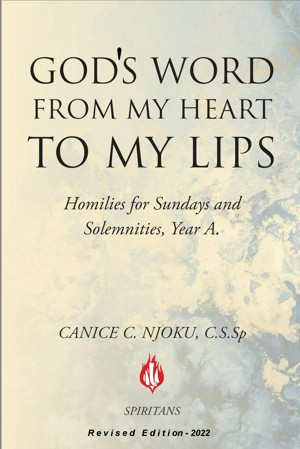
Available now on
Smashwords: https://www.smashwords.com/books/view/1179451
Amazon: https://www.amazon.com/dp/B094YSGTZF
There is a famous saying that to err is human, while to forgive is divine. That is to say, the one who sins acts humanly. This is because it is part of our human attributes to err or sin. On the other hand, the one who forgives acts divinely. This is because to forgive is to participate in an essential attribute and nature of God. That is His divinity. Our God is known for this. “He is compassionate, merciful, loving and forgiving” (Ps 102).
The first reading of today focuses on forgiveness. First, it reminds us that we must forgive others for our prayers to be answered. Second, it presupposes that we are all sinners needing God’s forgiveness. So, to be forgiven, we must first forgive others. Therefore, Sirac urges us: “Forgive your neighbor the hurt he does to you, and when you pray, your sins will be forgiven.” This is a call to liberate others to liberate and heal ourselves.
In the second reading, Paul reminds us of something fundamental. “The life and death of each of us influence the other.” Also, our ability to forgive has a significant influence on others as well as on ourselves. Hence, it is important to note that forgiveness has a double effect. It is a single-dose medicine that cures one or many persons simultaneously. It liberates the one who is forgiven and heals the one who forgives.

In the gospel, Christ takes forgiveness to a different and practical level. This unfolds in the dialogue between Peter and Christ. Peter asked a theoretical question: “How many times must I forgive my brother?” Jesus answered him most practically: “seventy-seven times.” Christ’s response reminds us that Christian forgiveness does not have limits. We must forgive all, always and forever, as the prayer of Sant Francisco of Assis says: “Wherever there is injury (offense or hurt), forgiveness.”
Hence, to demonstrate this, Jesus tells a proverb about the kingdom of heaven. Let us reflect on how often we have acted like a wicked servants. He was forgiven an outstanding debt but could not forgive his neighbor a little debt. He was set free, but he jailed his neighbor. The message of this parable is that we must treat others mercifully. We must forgive because God forgives us every day. We must not always hold our neighbors in contempt. Instead, we must consider their situations as God considers our situation always.
Jesus tells us to forgive all and forever. What does it mean to forgive all and forever? First, it does not mean: “I forgive you, but we must go our separate ways,” or I forgive you, but I do not want to see you again in my life,” or I forgive you, but I will not forget.” It means something much more profound. It means restoring unity and believing it is possible to walk together toward a common goal. It means to heal a wound without leaving a scar.
It is essential to add that, at times, one must forgive oneself for the faults committed against self. Endless grieving or guilt conscience because of one’s mistakes in life reduces one’s quality of life. It hinders both spiritual and material progress. So, we must forgive ourselves, too, to continue living in peace with ourselves.
Finally, he who forgives acts like Christ. So, as we pray today at this Eucharistic celebration: “Forgive us our offenses, as we forgive those who offend us,” let us ask God to help us to be true to these words by living them practically.
Peace be with you all!
Maranatha!
 frcanicenjoku