
Our World Needs our Light and Sweetness Now!
Readings: 1st: Is 58:7-10; Ps 111:4-9; 2nd: Heb 2: 1-5; Gos: Mat:5 13-16
Esta breve reflexión fue escrita por el Padre Canice Chukwuemeka Njoku, C.S.Sp., DMin., un sacerdote católico y miembro de la Congregación del Espíritu Santo (Espirítanos). Es un misionero en Puerto Rico. Es director del Santuario del Espíritu Santo, Dorado, y el Superior Mayor de la Congregación del Espíritu Santo (Espirítanos), Circunscripción de Puerto Rico y República Dominicana. El padre Canice es miembro de la Academia de Homilética (The Academy of Homiletics). Para más detalles y comentarios se puede contactarlo al: canice_c_njoku@yahoo.com, canicechukwuemeka@gmail.com.
Encuentra otros libros en: https://www.smashwords.com/books/view/904854
(Donar @ATH Móvil: Canice Njoku – 7873146309)
On this fifth Sunday of ordinary time, the Holy Mother Church reminds us that we are a light in the dark. Hence, she reminds her children that the light will be brighter if all Christians are like Christ.
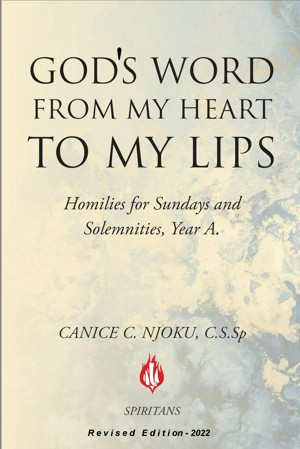
Available now on
Smashwords: https://www.smashwords.com/books/view/1179451
Amazon: https://www.amazon.com/dp/B094YSGTZF
In our first reading, the prophet Isaiah tells us what we must do for our light to shine: “Share your bread with the hungry, shelter the homeless, and cloth the naked.” These are what the Church calls corporal works of mercy. The United Nations declared them as Fundamental Human Rights in 1948. They are the necessities of life. So, their depravation rubs humanity of dignity and leaves her in perpetual darkness. This would amount to structural injustice and a sin against Charity. Therefore, we must be “that good man, who is light in the dark for the upright.”
In the second reading, Paul testified that he was “light” to the Corinthians. His presence illuminated their darkness. Also, as “salt,” he helped in preserving their salvation. He did this not only through his words but through his actions. He recalled thus: “When I came to you, brothers, it was not with any show of oratory or philosophy, but simply to tell you what God had granted.” Paul effortlessly did this through his words and good works.
He proved to be the light through which the pagan Corinthians saw the light of Christ. He was the salt that sweetened and preserved their lives. Therefore, our encounter with people must leave them better than we met them. It must wipe off the dust of worry, shame, despair, and disappointment. It must liberate them from ignorance and help them to appreciate the truth by drawing close to God.

In today’s gospel, Jesus calls us “salt.” In the Old Testament, salt was used to season the sacrificial offerings for sins and covenant with God. “Season all your grain offerings with salt; you shall not let the salt of the covenant with your God be lacking from your cereal offering.” (Lev 2:13). Also, land agreements were sealed with a gift of salt as proof of the strength and permanence of the contract. Salt was also a symbol of God’s activity in a person’s life. This is because it penetrates, preserves, and aids in healing. That is how God becomes active in our lives. So, when Christ calls us “salt,” he wants us to make a difference in our world. We must penetrate and preserve our world from moral, spiritual, physical, or environmental decay. As salts, we must add taste and flavor to people’s lives.
Again, Christ calls us “light.” He gives us a command: “Your light must shine in the sight of men!” Light does not shine for itself. Hence, Christ tells us why we must shine: “So that men may see your good works and give praise to God.” Good works here mean corporal and spiritual works of mercy, as we saw in our first reading.
To give praise means to acknowledge and to be moved. It means to be affected positively by our light. As light, we must represent: “What is good, pure, true, holy, and reliable” (Phil 4: 8).
Make a one-time donation
Make a monthly donation
Make a yearly donation
Choose an amount
Or enter a custom amount
Your contribution is appreciated.
Your contribution is appreciated.
Your contribution is appreciated.
DonateDonate monthlyDonate yearlyFinally, we must not conceal God’s gift. Since “charity begins at home,” we must first be light and salt in our homes and communities. Also, our world must feel the positive effects of our light. We must not starve it of the sweetness of our testimonies and good works.
Peace be with you!
Maranatha!
 frcanicenjoku