Homily For The 7th Sunday Of Ordinary Time, Year C

Essential Virtues And Elements Of Our Christian Life

Readings: 1st1 Sam 26:2, 7-9, 12-23; Ps 103; 2ndI Cor 15:45-49; Gos: Lk 6:27-38

This brief reflection was written by Fr. Njoku Canice Chukwuemeka, C.S.Sp. He is a Catholic Priest and a member of the Congregation of the Holy Spirit (Spiritans). He is a missionary in Puerto Rico. He is the Parish Priest of Parroquia la Resurrección del Senor, Canóvanas, and the Major Superior of the Congregation of the Holy Spirit (Spiritans), Circumscription of Puerto Rico and the Dominican Republic. He was the chancellor of the Diocese of Fajardo Humacao, Puerto Rico. Fr. Canice is a member of the Academy of Homiletics. For more details and comments contact him at: canice_c_njoku@yahoo.com, canicechukwuemeka@gmail.com

(https://orcid.org/0000-0002-8452-8392)

On this seventh Sunday, the Church reminds us of the essential virtues and elements of our Christian life. They include mercy and compassion, love of God and neighbor, self-control, appreciation of values, moral responsibility, awareness of sin, and the sacred sense. These are marks of our spiritual progress and Christian growth. Also, they form part of the church’s social doctrine.

https://ppeditoresebooks.com/products/homilies-c-god-s-word-from-my-heart-to-my-lips-ebook?_pos=3&_sid=de180b38d&_ss=r

Today’s first reading is dramatic. David had the death warrant of his enemies in his hands, yet he refused to pronounce it. Instead, he left it for God to pronounce in his way and at his appropriate time. He heeded God’s word: “Do not repay anyone evil for evil. Do not take revenge. Vengeance is mine” (Rom 12: 17-19; Deut 32:35).

In today’s Gospel, Jesus gave a very important sermon on these essential virtues and elements that must guide our lives and actions as Christians. It is a new commandment because it overrules the Old Testament law of reprisal attack or retributive justice. There is no doubt that humanly speaking, it is a very difficult one. However, it demands a lot of sacrifice and courage.

So, how do we reconcile our constant quest for justice with the virtues of mercy and compassion? Is there any common ground between them? This is especially, in our world, where we constantly speak of mercy and at the same time advocate for the strictest sense of justice. That is the maximum punishment (even the death penalty) for our offenders.

header.gif

(Donate @ATH Móvil: Canice Njoku)

The second-weekday preface of the Eucharistic (II) prayer gives us a clue to this problem. It says, “Injustice, God condemned us. In mercy, he redeemed us.” Yes, it is what it is. Indeed, contrary to what our society has programmed us to believe, justice and mercy are not mutually exclusive.

Hurts and wounds do not heal so fast. In some cases, their scars do not disappear entirely during one’s lifetime. However, Christ knew this perfectly well. He not only preached this sermon, but he also lived it. So, he is not asking us to do what he did not do.
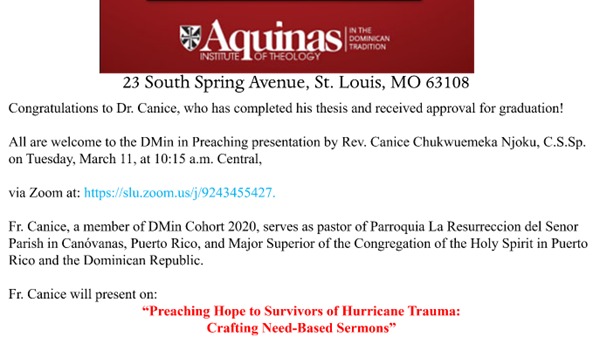
Link: On Tuesday, March 11, at 10:15 a.m. Central. Via Zoom at: https://slu.zoom.us/j/9243455427

Abstract @: “Preaching Hope to Survivors of Hurricane Trauma: Crafting Need-Based Sermons.” https://rim.ir.atla.com/concern/etds/d05a5efe-bf09-490c-af14-4600f7395d07

Paul reminds us in our second reading that we derived our body and way of life from the earthly man (Adam). In contrast, we derived the spirit that gives life and animates our body from the heavenly man (Christ).

Hence, the spirit guides those who have received Christ. They are born of the Spirit. Christ’s new commandment may seem complicated, his spirit and grace will enable us to live these essential virtues and elements of our Christian life.

There are some lessons for us from today’s readings. First, we must learn to leave vengeance for God. So, we must not take every opportunity for revenge against our offenders. Forgiveness heals all wounds and wipes all scars away.

Second, we must not always bow to pressures from circumstances or our colleagues to do evil. This is because two wrongs can never make one right. Reprisal attack or revenge may hurt one even more than it will hurt one’s offender. In this case, we may win the war but not the peace, love, and friendship.

Finally, no matter our situation or circumstance, we must not lose the sense of the sacred. We must guard against sin. All lives belong to God, and only he has the right to take them away. Also, let us remember that we cannot help God in his judgment. He knows what to do, how to do it, and the best time to do it. So, we must let God be God “Lord is merciful and kind.”

Peace be with you!

Maranatha!

Homilía del Séptimo Domingo del Tiempo Ordinario, Año C

Virtudes y elementos esenciales de nuestra vida Cristiana

Lecturas: 1ra: 1 Sam 26:2, 7-9, 12-23; Sal: 103; 2nd: I Cor 15:45-49; Ev: Lc 6:27-38

Esta breve reflexión fue escrita por el Padre Canice Chukwuemeka Njoku, C.S.Sp. Es un sacerdote católico y  miembro de la Congregación del Espíritu Santo (Espirítanos). Es un misionero en Puerto Rico. Es el Párroco de la Parroquia la Resurrección del Señor, Canóvanas y el Superior Mayor la Congregación del Espíritu Santo (Espirítanos), Circunscripción de Puerto Rico y Republica Dominicana. Fue el Canciller de la Diócesis de Fajardo Humacao, Puerto Rico. El Padre Canice es miembro de la academia de homilética (The Academy of Homiletics). Para más detalles y comentarios se puede contactarlo all:canice_c_njoku@yahoo.com, canicechukwuemeka@gmail.com.

(Donar @ATH Móvil: Canice Njoku)

(https://orcid.org/0000-0002-8452-8392)

En este séptimo Domingo, la Iglesia nos recuerda las virtudes esenciales y los elementos de nuestra vida cristiana. Incluyen: misericordia y compasión, amor de Dios y al prójimo, autocontrol y apreciación de los valores, responsabilidad moral, conciencia del pecado y, el sentido de lo sagrado. Estas son marcas de nuestro progreso espiritual y crecimiento cristiano. Estas también forman parte de la doctrina social de la iglesia.

https://ppeditoresebooks.com/products/homilias-c-palabra-de-dios-ebook?_pos=8&_sid=de180b38d&_ss=r

La primera lectura de hoy es muy dramática. David tenía la orden de muerte de sus enemigos en sus manos, sin embargo, se negó a pronunciarlo. Más bien, lo dejó para que Dios se pronuncie a su manera, y en su momento oportuno. Él escuchó la palabra de Dios: “No paguen a nadie mal por mal. La venganza es mía” (Ro 12:17-19; Deut 32:35).

En el Evangelio de hoy Jesús dio un sermón muy importante sobre estas virtudes esenciales y elementos que deben guiar nuestras vidas y acciones como cristianos. Es un mandamiento nuevo porque, anula la ley del antiguo testamento que se trata de ataque represalia o de la justicia retributiva. No hay duda de que, humanamente hablando, es muy difícil. Sin embargo, exige mucho sacrificio y valentía.

header.gif

Entonces, ¿cómo reconciliamos nuestra búsqueda constante de justicia con las virtudes de la misericordia y la compasión? ¿Hay algún terreno común entre ellos? Esto es especialmente, en nuestro mundo en el que constantemente hablamos de misericordia, y al mismo tiempo abogamos por el sentido más estricto de la justicia. Es decir, el castigo máximo (incluso la pena de muerte), para nuestros ofensores.

El segundo prefacio de la oración eucarística semanal nos da una pista de este problema cuando dice: “En la justicia Dios nos condenó, en misericordia nos redimió.” Sí, es lo que es. La justicia y la misericordia pueden ser mutuamente excluyentes contra lo que nuestra sociedad nos ha programado a creer.

El martes 11 de marzo a las 10:15 a.m. Centro vía Zoom: https://slu.zoom.us/j/9243455427.

Abstracto @: “Preaching Hope to Survivors of Hurricane Trauma: Crafting Need-Based Sermons.” https://rim.ir.atla.com/concern/etds/d05a5efe-bf09-490c-af14-4600f7395d07

Los dolores y las heridas no sanan tan rápido. En algunos casos, sus cicatrices no desaparecen completamente durante toda la vida de uno. Sin embargo, Cristo lo sabía perfectamente bien. No sólo predicó este sermón, sino que también lo vivió. Así que no nos pide que hagamos lo que no hizo.

Pablo nos recuerda en nuestra segunda lectura que, derivamos nuestro cuerpo y forma de vida del hombre terrenal (Adán). Mientras derivamos el espíritu que da vida y anima nuestro cuerpo del hombre celestial (Cristo).

Por lo tanto, aquellos que han recibido a Cristo son guiados por su espíritu. Nacen del espíritu. Aunque, el nuevo mandamiento de Cristo puede parecer difícil, su espíritu y su gracia nos ayudaran vivir estas virtudes esenciales y elementos de nuestra vida cristiana.

Hay tantas lecciones para nosotros de las lecturas de hoy. Primero, debemos aprender a dejar la venganza por Dios. Por lo tanto, no debemos aprovechar todas las oportunidades para la venganza contra nuestros delincuentes. El perdón cura todas las heridas y borra todas las cicatrices.

Segundo, no siempre debemos inclinarse ante las presiones de las circunstancias, o de nuestros colegas para hacer el mal. Esto es porque, dos males nunca equivalaran aun un buen acto. Un ataque de represalia o venganza puede herir a uno aún más de lo que lastimará a su ofensor. En este caso, podemos ganar la guerra, pero no la paz, el amor y la amistad.

Por último, no importa nuestra situación o circunstancia, no debemos perder el sentido de lo sagrado. Debemos protegernos contra el pecado. Además, recordemos que no podemos ayudar a Dios en su juicio. Él sabe qué hacer, cómo hacerlo, y el mejor momento para hacerlo. Por lo tanto, debemos dejar que Dios sea Dios. Porque, “El Señor es compasivo y misericordioso “.

¡La paz sea con ustedes!

¡Maranatha!

Homilía del Sexto Domingo del Tiempo Ordinario, Año C

Señor, Nuestra Confianza y Esperanza está en ti

Lecturas: 1ra: Jer 17:5-8; Sal: 1:1-6; 2da: I Co 15:12.16-20; Ev: Lc 6:17.20-26

Esta breve reflexión fue escrita por el Padre Canice Chukwuemeka Njoku, C.S.Sp. Es un sacerdote católico y  miembro de la Congregación del Espíritu Santo (Espirítanos). Es un misionero en Puerto Rico. Es el Párroco de la Parroquia la Resurrección del Señor, Canóvanas y el Superior Mayor la Congregación del Espíritu Santo (Espirítanos), Circunscripción de Puerto Rico y Republica Dominicana. Fue el Canciller de la Diócesis de Fajardo Humacao, Puerto Rico. El Padre Canice es miembro de la academia de homilética (The Academy of Homiletics). Para más detalles y comentarios se puede contactarlo all:canice_c_njoku@yahoo.com, canicechukwuemeka@gmail.com.

(Donar @ATH Móvil: Canice Njoku)

(https://orcid.org/0000-0002-8452-8392)

Hoy, el sexto domingo del tiempo ordinario, la Iglesia nos invita a poner nuestra confianza en Dios y en su único hijo Jesucristo. A través de su resurrección, Cristo conquistó la muerte y fortaleció nuestra fe y esperanza de la vida eterna.

https://ppeditoresebooks.com/products/homilias-c-palabra-de-dios-ebook?_pos=8&_sid=de180b38d&_ss=r

Por lo tanto, la primera lectura de hoy del libro de Jeremías nos recuerda sucintamente las consecuencias de confiar únicamente en nuestras habilidades, en nuestra fuerza humana y en los seres humanos. “Esto dice el Señor, maldito el hombre que confía en el hombre, que en él pone su fuerza y aparta del Señor su corazón.” A través de esto, se nos recuerda que todo esto nos fallará porque, nuestro éxito y supervivencia no dependen únicamente de ellos.

Por lo tanto, la primera lectura de hoy nos llama a una reflexión muy profunda. Debemos preguntarnos, ¿en quién y en qué he puesto mi confianza? Poner nuestra confianza en Dios es el mejor acercamiento a la vida. Ciertamente, debemos hacer esfuerzos y hacer lo que debemos hacer como seres humanos. Sin embargo, no debemos olvidar que, es Dios quien sostiene, confirma y bendice nuestros caminos y esfuerzos.

Debemos estar conscientes del hecho que, sin él, no somos nada como el Venerable Francis Libermann, C. S. Sp constantemente repetía antes de su muerte: “¡Dios es todo, el hombre es nada! ¡Dios es todo, el hombre es nada!

Confiar en Dios es una gran fuente de bendición y gozo interior. Por lo tanto, el salmista nos recuerda que: “Los que confían en el Señor son como el monte de Sion que nunca puede ser sacudido” (Sal 125:1).

header.gif
https://api.neonemails.com/emails/content/uhCdQs-DxLyWSwuFIvR7IHRFoOjmB1ujv8IGPCvRVmY=

En la segunda lectura, Pablo igualmente hace el mismo punto. Nuestra esperanza no debe ser totalmente colocada en este mundo ni en nuestros esfuerzos solos, sino en Cristo, que a través de su resurrección ha fortalecido nuestra esperanza de la eternidad.

Por lo tanto, Pablo nos dice: “Si nuestra esperanza en Cristo se redujera tan sólo a las cosas de esta vida, seríamos los más infelices de todos los hombres”. En otras palabras, la vida no termina aquí. Hay algo más allá de este mundo, y sólo nuestra esperanza en Cristo resucitado nos llevará allí. En pocas palabras, nuestro viaje con Cristo no termina aquí, sino que trasciende este mundo.

Mientras que nuestra primera lectura comenzó con una advertencia muy fuerte contra no confiar en Dios, el Evangelio de hoy comienza con una bendición para aquellos que están listos para hacer la voluntad de Dios. La bienaventuranza es un gran cantico que nos llama a una vida de virtud, de reflexión y de entrega total a la voluntad de Dios.

Es el cantico de Cristo que nos llama a confiar firmemente en Dios, mientras que esperamos la eternidad. Estas bendiciones son para aquellos que están totalmente dispuestos a confiar en Dios. Las Bienaventuranzas también nos recuerdan que todo lo que hacemos y trabajamos aquí nos ganará la vida eterna. Es decir, si los hacemos bien, y por Dios.

One-Time
Monthly
Yearly

Make a one-time donation

Make a monthly donation

Make a yearly donation

Choose an amount

$5.00
$15.00
$100.00
$5.00
$15.00
$100.00
$5.00
$15.00
$100.00

Or enter a custom amount

$

Your contribution is appreciated.

Your contribution is appreciated.

Your contribution is appreciated.

DonateDonate monthlyDonate yearly

Finalmente, la buena noticia para nosotros hoy es simple, nada en este mundo puede robarnos nuestra paz de la mente y la alegría interior, porque nuestra confianza no está en este mundo, ni en el hombre. Más bien, nuestra confianza está en Cristo crucificado y resucitado, el Salvador y la esperanza del mundo. El Salmista resume esta buena noticia para nosotros: “Dichoso el hombre que confía en el Señor”

¡La paz sea con ustedes!

¡Maranatha!

Homily For The 6th Sunday Of Ordinary Time, Year C

Lord, Our Trust, And Hope Is In You

Readings: 1st: Jer 17:5-8; Ps: 1:1-6; 2ndI Cor 15:12.16-20; Gos: Lk 6:17.20-26

This brief reflection was written by Fr. Njoku Canice Chukwuemeka, C.S.Sp. He is a Catholic Priest and a member of the Congregation of the Holy Spirit (Spiritans). He is a missionary in Puerto Rico. He is the Parish Priest of Parroquia la Resurrección del Senor, Canóvanas, and the Major Superior of the Congregation of the Holy Spirit (Spiritans), Circumscription of Puerto Rico and the Dominican Republic. He was the chancellor of the Diocese of Fajardo Humacao, Puerto Rico. Fr. Canice is a member of the Academy of Homiletics. For more details and comments contact him at: canice_c_njoku@yahoo.com, canicechukwuemeka@gmail.com

(Donate @ATH Móvil: Canice Njoku)

(https://orcid.org/0000-0002-8452-8392)

Today, the sixth Sunday of Ordinary Time, the church invites us to place our trust in God and in his only son, Jesus Christ. Through his resurrection, Christ conquered death and strengthened our faith and hope of eternal life.

https://ppeditoresebooks.com/products/homilies-c-god-s-word-from-my-heart-to-my-lips-ebook?_pos=3&_sid=de180b38d&_ss=r

So, today’s first reading from the book of Jeremiah succinctly reminds us of the consequences of trusting solely on our abilities, on our human strength, and on human beings: “Cursed is the one who trusts in human beings, who seeks his strength in flesh, whose heart turns away from the Lord.” Through this, we are reminded that all these will fail us because our success and survival do not depend solely on them.

So, today’s first reading calls us to a very deep reflection. We must ask ourselves, in who, and in what have I put my trust? Placing our trust in God is the best approach to life. certainly, we must make efforts and do what we must do as humans. However, we must not forget that it is God who sustains, confirms, and blesses our ways and efforts.

We must be conscious of the fact that without him, we are nothing as the venerable Libermann, C. S. Sp constantly repeated before his death: “God is all, man is nothing, God is all, man is nothing! To place one’s trust in God is a great source of blessing and interior joy. Hence, the psalmist reminds us that: “Those who trust in the Lord are like Mount Zion that can never be shaken” (Ps 125:1)

In the second reading, Paul equally makes the same point. Our hope must not be totally placed on this world or on our efforts alone, but on Christ who through his resurrection has strengthened our hope of eternity.

header.gif

Hence, Paul tells us: “If for this life only we have hoped in Christ, we are the most pitiable people of all.” In other words, life does not end here. There is something beyond this world, and only our hope in the resurrected Christ will take us there. Simply put, our journey with Christ does not end here, it transcends this world.

While our first reading began with a very strong warning against not trusting in God, today’s gospel begins with a blessing for those who are ready to do God’s will. The beatitude is a great song that calls us to a life of virtue, reflection, and total surrender to God’s will.

It is Christ’s song that calls us to trust firmly in God while looking forward to eternity. These blessings are for those who are totally and willingly ready to place everything in God’s hands. The beatitudes also remind us that all we do and work for here will gain us eternal life. That is if we do them well and for the sake of God.

One-Time
Monthly
Yearly

Make a one-time donation

Make a monthly donation

Make a yearly donation

Choose an amount

$5.00
$15.00
$100.00
$5.00
$15.00
$100.00
$5.00
$15.00
$100.00

Or enter a custom amount

$

Your contribution is appreciated.

Your contribution is appreciated.

Your contribution is appreciated.

DonateDonate monthlyDonate yearly

Finally, the good news for us today is simple, nothing in this world can rob us of our peace of mind and interior joy, because our trust is not in this world, nor in man. Rather, our trust is in the crucified and rise, Christ, the savior and hope of the world. The psalmist summarized this good news for us: “Happy the man who has placed his trust in the Lord.”

Peace be with you!

Maranatha

Homily For The 5th Sunday Of Ordinary Time, Year C

The Lord Sanctifies And Makes Us Worthy Messengers

Readings: 1st: Is 6:1-8; Ps: 137; 2ndI Cor 15:1-11; Gos: Lk 5:1-11

This brief reflection was written by Fr. Njoku Canice Chukwuemeka, C.S.Sp. He is a Catholic Priest and a member of the Congregation of the Holy Spirit (Spiritans). He is a missionary in Puerto Rico. He is the Parish Priest of Parroquia la Resurrección del Senor, Canóvanas, and the Major Superior of the Congregation of the Holy Spirit (Spiritans), Circumscription of Puerto Rico and the Dominican Republic. He was the chancellor of the Diocese of Fajardo Humacao, Puerto Rico. Fr. Canice is a member of the Academy of Homiletics. For more details and comments contact him at: canice_c_njoku@yahoo.com, canicechukwuemeka@gmail.com

(Donate @ATH Móvil: Canice Njoku)

(https://orcid.org/0000-0002-8452-8392)

Last Sunday, the church reminded us of our privileged call to be God’s prophets and messengers. On this fifth Sunday of ordinary time, she reminds us that though we are utterly unworthy to be God’s messengers, Christ cleanses us from our sins and gives us the strength to say: “Here I am, Lord send me.” He is the one that makes us worthy missionaries.

https://ppeditoresebooks.com/products/homilies-c-god-s-word-from-my-heart-to-my-lips-ebook?_pos=3&_sid=de180b38d&_ss=r

A close look at all our readings today reveals one common phenomenon. This is the feeling and expression of unworthiness by all the personalities (Isaiah, Paul, and Peter). Given that they were human beings, they were not worthy of God’s mission. This is why the scripture tells us that: There is none as holy as the Lord (I Sam. 2, 2), and that “All our righteous acts are like filthy rags (Is. 64:6).

Of course, any person who grasps this truth is already on the path of salvation. These feelings and expressions of unworthiness were marks of humility on Isaiah who said: “I am a man of unclean lips,” on Paul who admitted: “I am the least of the apostles,” and on Peter who Pleaded: Leave me, Lord; I am a sinful man.”

They acknowledged their unworthiness before God. They acknowledged the fact that they were not worthy to bear the sacred message of God. Somehow, their feelings and humility were indirect means of drawing God’s attention that they needed his grace and blessing to succeed. However, it did not matter to God whether they were weak or strong. He is simply the one who sanctifies and makes us worthy of his work.

In today’s gospel, one question that needs serious attention is: How could Peter, a professional and experienced fisherman who could not catch any fish throughout the night, be able to catch men for God?  “Men” who are the most difficult of all the species created by God? Of course, Christ knew he was not worthy, yet He went for him. Christ chose him despite his unworthiness and made him worthy for the mission. From the lives and excuses of these figures today, we must learn that it is the grace of God that makes us worthy for His mission and not only our “special qualities or experiences.” They matter but are limited.

header.gif

There is another crucial truth and lesson that emerges from our readings today. This is the fact that there will always be millions of reasons to try to avoid the call of God. Last week, while Jeremiah claimed that he was still too young (Jer 1, 6), today Isaiah declares he is “A man of unclean leaps.” So, there will always be millions of reasons not to help the poor, feed the hungry, clothe the naked, shelter the homeless, visit the sick, and even bury the dead.

There will be a million reasons not to attend masses, not to pray the rosary, not to go for confession when we need it, not to visit Christ in the Blessed Sacrament. There will always be reasons not to take care of my wife, husband, children, and neighbors. Too many excuses, my dear friend! However, God will not relent until we do his will.

Finally, at times we feel like Isaiah, Paul, or Peter in today’s readings. We feel so unworthy of our call that we can hardly do anything for the sake of the Gospel. Rightly, we should feel so, perhaps because of our inadequacies and fear. However, we should realize that God is the one who cleanses us of our sins and makes us worthy to be his messengers.

Therefore, we are not to be afraid. Instead, we should be docile to the spirit of Jesus Christ. He makes only those who are available worthy and capable for his mission. So, like Isaiah, let us confidently say: Here I am, Lord send me, “and Christ will make us “fishers of men.”

Peace be with you.

Maranatha!

Homilía del Quinto Domingo del Tiempo Ordinario, Año C

El Señor nos hace sus dignos mensajeros

Lecturas: 1ra: Is 6,1-8; Sal: 137; 2da: I Co 15:1-11; Ev: Lc 5,1-11

Esta breve reflexión fue escrita por el Padre Canice Chukwuemeka Njoku, C.S.Sp. Es un sacerdote católico y  miembro de la Congregación del Espíritu Santo (Espirítanos). Es un misionero en Puerto Rico. Es el Párroco de la Parroquia la Resurrección del Señor, Canóvanas y el Superior Mayor la Congregación del Espíritu Santo (Espirítanos), Circunscripción de Puerto Rico y Republica Dominicana. Fue el Canciller de la Diócesis de Fajardo Humacao, Puerto Rico. El Padre Canice es miembro de la academia de homilética (The Academy of Homiletics). Para más detalles y comentarios se puede contactarlo all:canice_c_njoku@yahoo.com, canicechukwuemeka@gmail.com.

(Donar @ATH Móvil: Canice Njoku)

(https://orcid.org/0000-0002-8452-8392)

El pasado domingo, la iglesia nos recordaba nuestra privilegiado llamado a ser profetas y mensajeros. En este quinto domingo del tiempo ordinario, nos recuerda que a pesar de que somos absolutamente indignos de ser mensajeros de Dios, Cristo nos limpia de nuestros pecados y nos da la fuerza para decir: “Aquí estoy, Señor envíame.” Él es el único que nos hace dignos misioneros. Por lo tanto, el mensaje de hoy es una continuación de la semana pasada.

https://ppeditoresebooks.com/products/homilias-c-palabra-de-dios-ebook?_pos=8&_sid=de180b38d&_ss=r

Un vistazo a todas nuestras lecturas hoy revela un fenómeno común. Este es el sentir y la expresión de indignidad por todas las personalidades (Isaías, San Pablo y San Pedro). Verdaderamente y dado que son seres humanos, no son dignos de la misión de Dios. Esta es la razón por la cual la escritura nos dice que: “No hay uno santo como el Señor… (I Sam 2, 2); y que: “Todas nuestras justicias son como trapos de inmundicia ante Dios” (Is 64, 6).

Por supuesto, cualquier persona que capta esta verdad está ya en el camino de la salvación. Estos sentimientos y expresiones de indignidad habían marcado la humildad de Isaías, que dijo: “Yo soy un hombre de labios impuros”, en San Pablo, quien confesó: “Yo soy el más pequeño de los apóstoles”, y en Pedro, que se confesó: “Señor, yo soy un hombre pecador”.

Se han reconocido sus afectos, sus debilidades y vulnerabilidades ante Dios. Se han reconocido el hecho de que no son dignos de llevar el mensaje sagrado de Dios. De alguna manera, sus sentimientos y humildad son medios indirectos de dibujar la atención de Dios al hecho de que se necesita su gracia y bendición para tener éxito. Por supuesto, Dios conocía a todos ellos antes de elegirlos. No le importa si son fuertes o débiles. Dios es el que santifica y nos hace dignos de su trabajo.

En el evangelio de hoy, una cuestión que habría que prestar mucha atención es la siguiente: ¿Cómo podría Pedro un profesional y experimentado pescador que no podía coger ningún pez a lo largo de la noche ser capaz de capturar los hombres para Dios? Es decir, “Homo sapiens” que son los más difíciles de todas las especies creadas por Dios.

header.gif

Por supuesto, Cristo sabía que no era digno, pero fue para Él. Le escogió a pesar de su indignidad y le hizo merecedor de la misión. De las vidas y las experiencias de estas figuras, tenemos que aprender que es la gracia de Dios que nos hace dignos de su misión y no sólo de nuestras “cualidades especiales o las experiencias.” Son importantes, pero son limitadas.

Hay otra importante verdad y lección que se extrae tanto de nuestras lecturas hoy y la primera lectura de la semana pasada. Este es el hecho de que, siempre habrá millones de razones para tratar de eludir el llamado de Dios. La semana pasada, mientras que Jeremías dijo que él era demasiado joven (Jer 1, 6), hoy Isaías afirma que él es “un hombre de labios impuros.” Por lo tanto, siempre habrá millones de razones, para no ayudar a los pobres, los hambrientos, dar a beber al sediento, vestir al desnudo, dar refugio a los desamparados, visitar a los enfermos, los presos, enterrar a los muertos.

Habrá millones de razones para no asistir a las misas, no rezar el rosario, para no ir a la confesión cuando lo necesitamos, para no visitar a Cristo en el Santísimo Sacramento. Siempre habrá razones para no ser capaz de cuidar de mi esposa, mi marido, mis hijos y mis vecinos. ¡Demasiadas razones, mi querido amigo! Sin embargo, Dios no descansará hasta que no hagamos su voluntad, puesto que tiene una respuesta adecuada para cada razón por la que damos.

Por último, a veces nos sentimos como Isaías, Pablo o Pedro, según las lecturas de hoy. Nos sentimos tan indignos de nuestra llamada que no podemos hacer nada por el bien del Evangelio. Con toda razón, hemos de sentir eso, tal vez debido a nuestra insuficiencia y el miedo. Sin embargo, debemos ser conscientes que es Dios quien nos limpia de nuestros pecados y nos hace dignos de ser sus mensajeros.

Por lo tanto, no vamos a tener miedo. Más bien, debemos ser dóciles al espíritu de Jesucristo. Lo hacen sólo aquellos que están disponibles a ser dignos y capaces para su misión. Si estamos dispuestos a decir como Isaías: “Aquí estoy, envíame,” Cristo también está dispuesto a hacernos “pescadores de hombres”.

¡La paz sea con ustedes!

¡Maranatha!

Homilía para la Presentación del Señor (4to domingo), Año C

Presentemos a Nosotros Mismos a Dios, como un Sacrificio Vivo y Santo

Lecturas: 1ra: Mal 3:1-4; Sal 23:7-10; 2da: Heb 2:14-18; Gos: Lc 2: 22-40

Esta breve reflexión fue escrita por el Reverendo Padre Njoku Canice Chukwuemeka, C.S.Sp. Él es un sacerdote católico y un miembro de la Congregación de los Padres y Hermanos del Espíritu Santo (Espirítanos). Él está trabajando con el Grupo Internacional Espirítano De Puerto Rico y República Dominicana. Él es el administrador de la Parroquia La Resurrección del Señor, Canóvanas y el Canciller de la Diócesis de Fajardo-Humacao, Puerto Rico. Para más detalles y comentarios se puede contactarlo en: canice_c_njoku@yahoo.com, cancilleriadfh@gmail.com, canicechukwuemeka@gmail.com.

(Donar @ATH Móvil: Canice Njoku)

(https://orcid.org/0000-0002-8452-8392)

Hoy, es la fiesta de la presentación del Señor y la jornada mundial de la Vida Consagrada. También, es la la fiesta (el 173º aniversario de la muerte del Padre Francisco Libermann, C.S.Sp., el 2 de febrero de 1852), uno de los fundadores de mi orden religiosa – la Congregación del Espíritu Santo, bajo la protección del Inmaculado Corazón de María, (Espiritanos). Como Cristo fue presentado en el templo, hoy, la Santa Madre Iglesia nos invita a ofrecernos continuamente “como un sacrificio vivo, santo y agradable a Dios.” (Ro 12:1).

HOMILIAS C – PALABRA DE DIOS – Ebook

En nuestra primera lectura, el profeta Malaquías prepara nuestra mente para la venida del Señor: “Y el Señor que buscas entrará repentinamente en el templo.” Esta profecía se cumplió tanto en la segunda lectura como en el Evangelio de hoy. Una pregunta importante hoy es, ¿cuándo y cómo encontraré al Señor?

Al reflexionar sobre la celebración de hoy, la canción de Jude Nnam vino a la mente: “¿Qué le ofreceré al Señor para hacerlo feliz?” Cuando viene, espera que seamos fuertes y santos. Malaquías lo dice así: “La ofrenda de Judá y Jerusalén será entonces acogida por el Señor como en los días anteriores, como en los años de antaño.” Dios está listo para venir a nosotros. Por lo tanto, debemos prepararnos constantemente para recibirlo con acción de gracias.

La carta a los hebreos nos recuerda que Cristo es un sumo sacerdote fiel. En cumplimiento de la profecía de Malaquías, entró en el templo, se presentó y se sacrificó a Dios para nuestra salvación. Para lograr esta misión, tenía que ser como uno de nosotros, asumiendo nuestra naturaleza. Completó su presentación en el templo en la cruz: Así que, por su muerte, pudo quitarle todo el poder del diablo… y liberar a todos los que habían sido retenidos en la esclavitud. Por lo tanto, entró en el templo, tanto como el sacerdote y como la víctima.

En el Evangelio de hoy, a través de su presentación, sus padres lo acompañaron a comenzar su misión en el lugar correcto, el templo. Sin embargo, como adulto, se ofreció públicamente en la cruz. A través de esta presentación pública y oferta de sí mismo, ahora participamos en su vida. La lección que debemos aprender de esto incluye que, no hay límite a lo que podamos ofrecernos a Dios.

Además, el Evangelio de hoy nos recuerda que Dios es fiel a su promesa. Esto es especialmente, a los que le aman y son fieles a él. La profecía de Malaquías se cumplió en el evangelio de hoy. Esto es porque, Simeón y Ana se encontraron con el Señor en el templo de una manera y en un momento que menos esperaban: “El Señor que están buscando entrará repentinamente en el templo”.

Ellos sabían de su venida, esperaban encontrarse con él, pero nunca supieron cuándo sería esto, hasta que de repente apareció en el templo. Ambos agradecieron, y bendijeron al Señor por su fidelidad. Verdaderamente, “se concederá el deseo de los justos” (Prov 10:24). Por lo tanto, Simeón cantó el Nunc dimittis: “Ahora, Maestro, puedes dejar ir a tu siervo en paz… porque mis ojos han visto tu salvación…”

Por último, hoy, al conmemorar la presentación del Señor y del día mundial de la vida consagrada, oremos para que nosotros también, podamos presentar y consagrarnos continuamente a Dios como un sacrificio vivo y digno para la salvación de la humanidad. Felicidades a todos los religiosos consagrados de buena voluntad en mundo entero.

¡La Paz sea con ustedes!

¡Maranata!

Homily for Presentation of the Lord(4th Sunday),Year C 

Let Us Present Ourselves as a Living and Holy Sacrifice to God

Readings: 1st: Mal 3:1-4; Ps 23:7-10; 2nd: Heb 2:14-18; Gos: Lk 2:22-40

This brief reflection was written by Rev. Fr. Njoku Canice Chukwuemeka, C.S.Sp. He is a Catholic Priest and a Member of the Congregation of the Holy Ghost Fathers and Brothers (Spiritans). He is currently working with the Spiritan International Group of Puerto Rico &  Dominican Republic. He is the Administrator of Parroquia La Resurrección del Senor, Canovanas and the Chancellor of the Diocesis of Fajardo-Humacao, Puerto Rico. For more details and comments contact him on: canice_c_njoku@yahoo.com, cancilleriadfh@gmail.com, canicechukwuemeka@gmail.com.

(Donate @ATH Móvil: Canice Njoku)

(https://orcid.org/0000-0002-8452-8392)

Today is the Feast of the Presentation of the Lord and World Day of Consecrated Life. Also, it is the Feast Day (the 173rd anniversary of the death of Father Francis Libermann, C.S.Sp., 2 February 1852), one of the founders of my religious order – The Congregation of the Holy Spirit under the protection of the Immaculate Heart of Mary, also known as the Congregation of the Holy Ghost Fathers and Brothers (Spiritans). As Christ was presented in the temple today, the holy Mother Church invites us to continuously offer ourselves “as a living, holy, and pleasing sacrifice to God.” (Rom 12:1).

HOMILIES C – GOD’S WORD FROM MY HEART TO MY LIPS – Ebook

In our first reading, Prophet Malachi prepares our minds for the coming of the Lord: “And the Lord you are seeking will suddenly enter the temple.” This prophecy is fulfilled in both today’s second reading and gospel. One question that suffices today is, when and how do I meet the Lord?

As I reflected on today’s celebration, Jude Nnam’s song came to mind: “What shall I offer to the Lord to make Him happy?” When he comes, he expects us to be strong and holy. Malachi puts it this way: “The offering of Judah and Jerusalem will then be welcomed by the Lord as in former days, as in years of old.” God is ready to come to us. So, we must constantly prepare ourselves to receive him with thanksgiving.

The letter to the Hebrews reminds us that Christ is a faithful high priest. In Fulfilment of the prophecy of Malachi, He entered the temple, presented and sacrificed himself to God for our salvation. To achieve this mission, He had to be like one of us by assuming our nature. He completed His presentation in the temple on the cross: So that by his death, he could take away all the power of the devil…and set free all those who had been held in slavery.” Hence, He entered the temple, both as the priest and the victim.

In today’s gospel, through His presentation, his parents accompanied him to begin his mission in the right place, the temple. However, as an adult, He offered himself publicly on the cross. Through this public presentation and offer of himself, we now participate in his life. The lessons we are to learn from this include that, there is no limit to which we can offer ourselves to God.

Also, today’s gospel reminds us that God is faithful to his promise. This is especially to those who love and are faithful to him. Malachi’s prophecy was fulfilled in today’s gospel. This is because Simeon and Anna encountered the Lord in the temple in a way and at a time they least expected: “The Lord you are seeking will suddenly enter the temple.”

They knew about His coming and hoped to meet Him, but they never knew when this would be until He suddenly appeared in the temple. They both thanked and blessed the Lord for his faithfulness. Truly, “the desire of the righteous shall be granted” (Prov 10:24). Hence, Simeon sang the Nunc dimittis“Now, Master, you may let your servant go in peace… for my eyes have seen your salvation.” 

One-Time
Monthly
Yearly

Make a one-time donation

Make a monthly donation

Make a yearly donation

Choose an amount

$5.00
$15.00
$100.00
$5.00
$15.00
$100.00
$5.00
$15.00
$100.00

Or enter a custom amount

$

Your contribution is appreciated.

Your contribution is appreciated.

Your contribution is appreciated.

DonateDonate monthlyDonate yearly

Finally, today, as we commemorate the presentation of the Lord and World Day of the Consecrated Life, let us pray that we, too, may continuously present and consecrate ourselves to God as a living and worthy sacrifice for the salvation of humanity. Congratulations to all consecrated religious men and women of goodwill all over the world.

Peace be with you!

Maranatha!

Homily For the 3rd Sunday Of Ordinary Time, Year C

The Good News Liberates Us

Rdgs: 1stNeh 8:2-6.8-10; Ps: 18; 2ndI Cor 12:12-14.27; Gos: Lk 1:1-4.4:14-21

This brief reflection was written by Fr. Njoku Canice Chukwuemeka, C.S.Sp. He is a Catholic Priest and a member of the Congregation of the Holy Spirit (Spiritans). He is a missionary in Puerto Rico. He is the Parish Priest of Parroquia la Resurrección del Senor, Canóvanas, and the Major Superior of the Congregation of the Holy Spirit (Spiritans), Circumscription of Puerto Rico and the Dominican Republic. He was the chancellor of the Diocese of Fajardo Humacao, Puerto Rico. Fr. Canice is a member of the Academy of Homiletics. For more details and comments contact him at: canice_c_njoku@yahoo.com, canicechukwuemeka@gmail.com

(Donate @ATH Móvil: Canice Njoku)

(https://orcid.org/0000-0002-8452-8392)

On this third Sunday of ordinary time, we rejoice in the Good News of Salvation. This good news binds us together as the people of God and enables us to work for the kingdom of God. Christ himself is this Good News that brings us salvation. So, the church invites us to listen to the Good News and meditate on it in our hearts.

https://ppeditoresebooks.com/products/homilies-c-god-s-word-from-my-heart-to-my-lips-ebook?_pos=3&_sid=de180b38d&_ss=r

In our first reading, after the people had worked together to achieve their goal and freedom, Nehemiah gathered them and read the good news to them. After listening and meditating on the word of God, the people echoed, “Amen!”

In our second reading today, through his letter to the Corinthians, Paul encourages us to remain united and work together as one body of Christ. To achieve this, everyone must be considered important. There must be reconciliation, understanding, truthfulness, and respect for one another.

In today’s gospel, Luke narrates his own “solid and ordered account” of the events about Christ. His audience is “Theophilus.” This Greek name simply means “lover or seeker of God.” Historically speaking, there was no known figure named Theophilus at the time when Luke wrote his account. So, it is believed that Theophilus simply refers to all who love or seek God. Therefore, this good news is for all of us and our salvation.

Today, Jesus presents to us his program of evangelization. His program is the fulfillment of the prophecy of Isaiah 61: “The Spirit of the Lord is upon me to bring good news to the poor, to proclaim liberty to captives, to proclaim the Lord’s year of favor.”  This prophecy was made eight centuries before the birth of Christ. This was when the Israelites lived in slavery and misery in exile.

Hence, Isaiah’s prophecy was a call to liberation. So, by using these same words as the basis of his ministry and mission, Christ announces His reign of peace, justice, freedom, and love to all those suffering from all kinds of oppression and injustice.  

header.gif

Like Nehemiah in our first reading, today, Christ proclaims the good news of the new era to all of us. It is important to note that this good news is not directed only to the materially poor, but to all who are poor in spirit as Christ taught us in His beatitudes: “Blessed are the poor in spirit for theirs is the kingdom of God” (Mt 5, 3).

In order words, the kingdom that Christ has come to establish is open to all who will humbly receive him. All those who have the necessary disposition to receive the good news are poor in spirit. These necessary dispositions include charity and generosity, which manifests in service towards all.

The good news liberates us from two types of slavery. The first is the personally imposed slavery, which results from our personal sins and mistakes in life. This slavery makes us spiritually exiled, blind, and deaf. It cripples our spiritual life and hardens our hearts against God, and all that is good.

One-Time
Monthly
Yearly

Make a one-time donation

Make a monthly donation

Make a yearly donation

Choose an amount

$5.00
$15.00
$100.00
$5.00
$15.00
$100.00
$5.00
$15.00
$100.00

Or enter a custom amount

$

Your contribution is appreciated.

Your contribution is appreciated.

Your contribution is appreciated.

DonateDonate monthlyDonate yearly

The other type of slavery is that which is imposed on us by society. These include structural, economic, and physical injustices that do not allow us to live a fulfilled life in this world. Both of these are grave sources of pain and burden to us. Our liberation from the first slavery gives us the strength to combat the second. This is because Christ strengthens us to endure and overcome all.

Peace be with you!

Maranatha!

Homilía del Tercer Domingo del Tiempo Ordinario, Año C

La Buena Nueva Nos Libera

Lectura: 1raNeh 8, 2-6. 8-10; Sal: 18; 2da: I Co 12:12-14. 27; Ev: Lc 2:1-4. 4, 14-21

Esta breve reflexión fue escrita por el Padre Canice Chukwuemeka Njoku, C.S.Sp. Es un sacerdote católico y  miembro de la Congregación del Espíritu Santo (Espirítanos). Es un misionero en Puerto Rico. Es el Párroco de la Parroquia la Resurrección del Señor, Canóvanas y el Superior Mayor la Congregación del Espíritu Santo (Espirítanos), Circunscripción de Puerto Rico y Republica Dominicana. Fue el Canciller de la Diócesis de Fajardo Humacao, Puerto Rico. El Padre Canice es miembro de la academia de homilética (The Academy of Homiletics). Para más detalles y comentarios se puede contactarlo all:canice_c_njoku@yahoo.com, canicechukwuemeka@gmail.com.

(Donar @ATH Móvil: Canice Njoku)

(https://orcid.org/0000-0002-8452-8392)

En este tercer domingo del tiempo ordinario, nos alegramos de la buena nueva de la salvación que Cristo nos trae. Esta Buena Nueva nos une como el pueblo de Dios, y nos permite trabajar por el reino de Dios. Cristo mismo es la Buena Nueva que nos lleva a la salvación. Así pues, la iglesia nos invita a escuchar y meditar sobre la buena nueva en nuestros corazones.

https://ppeditoresebooks.com/products/homilias-c-palabra-de-dios-ebook?_pos=8&_sid=de180b38d&_ss=r

En nuestra primera lectura, después que la gente había trabajado junto con el fin de lograr su objetivo y de la libertad, Nehemías los reunió, y leyó las buenas nuevas para ellos. Después de escuchar y meditar en la palabra de Dios, el pueblo se hizo eco “Amen.”

En nuestra segunda lectura de hoy, a través de su carta a los Corintios, san Pablo nos anima a permanecer unidos y trabajar juntos como un solo cuerpo de Cristo. Para lograr este objetivo, todos deben ser considerados importantes. Deben tener reconciliación, comprensión, veracidad y respeto al otro.

En el Evangelio de hoy, Lucas narra su propio “sólido y ordenada cuenta” de los hechos de Cristo. Su público es “Teófilo”. Este nombre griego significa simplemente “amante o buscador de Dios.” Históricamente hablando, no se conoce la figura llamada Teófilo en el momento cuando Lucas escribió. Por lo tanto, se cree ampliamente que Teófilo se refiere simplemente a todos los que aman o buscan a Dios. Por lo tanto, esta Buena Nueva es para todos nosotros y para nuestra salvación.

Hoy, Jesús nos presenta su programa de evangelización. Su programa es el cumplimiento de la profecía de Isaías 61: “El Espíritu del Señor está sobre mí porque Él me ha ungido…para traer la buena nueva a los pobres, para anunciar a los cautivos la libertad, para proclamar el año de gracia del Señor…” Esta profecía se hizo ocho siglos antes del nacimiento de Cristo. Fue en ese momento cuando los Israelitas vivían en la esclavitud y la miseria en el exilio.

header.gif

Por lo tanto, la profecía de Isaías es una llamada a la liberación. Pero usando las mismas palabras como la base de su ministerio y misión, Cristo anuncia su reinado de paz, justicia, libertad y amor a todos aquellos que sufren de todo tipo de opresión y de la injusticia.

Como Nehemías en nuestra primera lectura, hoy Cristo proclama la buena nueva de la nueva era para todos nosotros. Es importante señalar que esta buena nueva no está dirigida sólo a los materialmente pobres, sino a todos los que son pobres en espíritu como Cristo nos enseñó en sus bienaventuranzas: “Dichosos los pobres en espíritu, porque de ellos es el reino de Dios” (Mt 5, 3).

En otras palabras, el reino que Cristo ha venido a establecer está abierto a todos aquellos que, humildemente le reciben. Todos aquellos que tengan la necesaria disposición para recibir las buenas noticias, son pobres de espíritu. Estas disposiciones son la caridad y la generosidad con que se manifiesta en el servicio a los pobres y a todos los que sufren en diferentes formas.

La buena noticia nos libera de dos tipos de esclavitud. La primera es la esclavitud que imponemos personalmente sobre nosotros mismos. Este es el resultado de nuestros pecados personales y los errores en la vida. Esta esclavitud nos hace, espiritualmente exiliados, ciegos y sordos. Atrofia nuestra vida espiritual, y se endurece nuestro corazón contra Dios y todo lo que es bueno.

Es la peor forma de esclavitud, porque nos afecta tanto espiritual como físicamente. Sólo Cristo puede liberarnos de la esclavitud. Podemos lograr esta liberación por aceptar la buena nueva, y por buscar la reconciliación con Cristo y con nosotros mismos.

One-Time
Monthly
Yearly

Make a one-time donation

Make a monthly donation

Make a yearly donation

Choose an amount

$5.00
$15.00
$100.00
$5.00
$15.00
$100.00
$5.00
$15.00
$100.00

Or enter a custom amount

$

Your contribution is appreciated.

Your contribution is appreciated.

Your contribution is appreciated.

DonateDonate monthlyDonate yearly

El otro tipo de esclavitud es la que se nos impone por la sociedad. Estos incluyen los estructurales, económicos y físicos, injusticias que no nos permiten vivir una vida realizada en este mundo. Ambos son graves fuentes de dolores y cargas para nosotros.

Sin embargo, es importante señalar que la liberación de nuestra esclavitud personalmente impuesta nos da la fuerza para luchar contra la segunda forma de esclavitud. Esto es así porque Cristo nos fortalece para resistir y vencer. Así que con nuestro salmista hoy vamos a exaltar al Señor: “Tus palabras, Señor, son espíritu y vida”.

¡La paz sea con ustedes!

¡Maranatha!